








Shiba Inu’s price action suggests it may be nearing the bottom of its local cycle, with technical indicators signaling potential exhaustion of the downtrend.
What to Know:
- Shiba Inu’s price action suggests it may be nearing the bottom of its local cycle, with technical indicators signaling potential exhaustion of the downtrend.
- Ethereum’s recent decline below $3,000 represents a structural change, requiring investors to closely monitor key price levels for potential support and resistance.
- XRP demonstrates resilience due to consistent buyer interest around its current price range, coupled with its institutional significance in cross-border payment infrastructure.
The digital asset market is currently navigating a complex landscape, with assets like Ethereum, XRP, and Shiba Inu exhibiting varied signals. While some indicators suggest a potential bottoming out in the short to medium term, the overall market structure remains cautiously positioned. Institutional investors are closely watching these dynamics, assessing whether current levels represent buying opportunities or a continuation of broader bearish trends.
Shiba Inu’s Potential Bottom
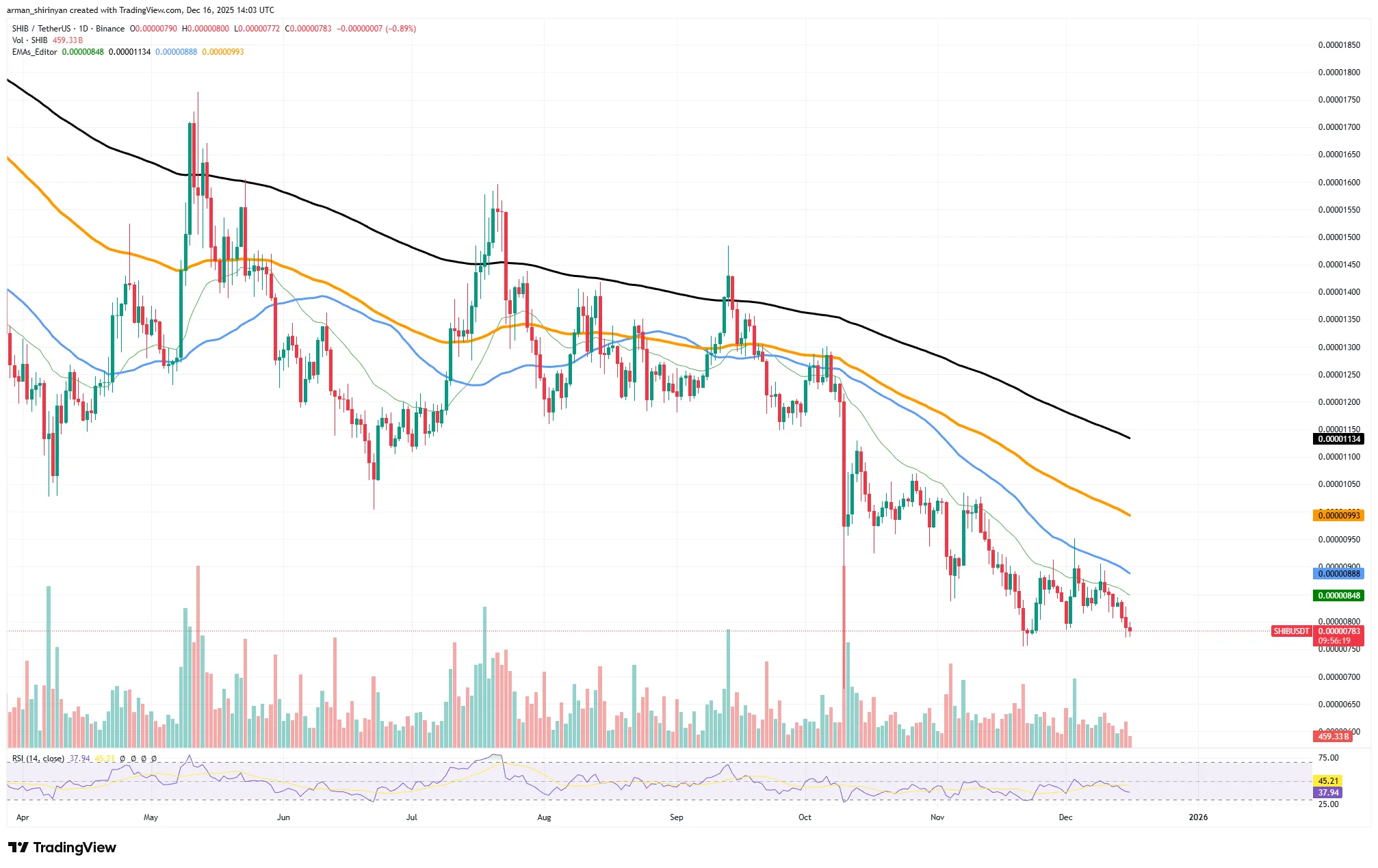
Shiba Inu (SHIB) is trading at levels that increasingly resemble the bottom of its local cycle. The price has compressed into a narrow range near long-term support after months of downward pressure, positioning it significantly below major moving averages. Historically, such a structure often precedes a waning of downside momentum, even though surface-level price action may appear unattractive.
From a technical perspective, SHIB is in the exhaustion phase of a late-stage downtrend. While the 200-day moving average remains far above the current price, confirming the broader bearish trend, the distance from this average is crucial. The recent sell-off has stretched SHIB significantly to the downside, leading to a collapse in volatility. Markets tend to either reverse or enter a prolonged accumulation phase, and SHIB is currently leaning towards the latter.
Ethereum’s Structural Shift
Ethereum’s (ETH) decline below $3,000 marks a notable structural change, prompting a reevaluation of short-term expectations. The failure of ETH to recover above declining moving averages underscores continued seller control. This doesn’t necessarily signal a macro trend reversal, but it highlights critical price points for investors to monitor.
The immediate support zone lies between $2,900 and $2,850, where buyers are attempting to stabilize the price. Losing this zone would confirm the $3,000 breakdown as a continuation move. The next key level is $2,700-$2,600, representing cycle support aligned with historical high-volume trading activity. To negate the bearish structure, ETH needs to reclaim the $3,200-$3,300 range, which coincides with declining moving averages and previously lost support.
XRP’s Resilience and Institutional Backing
Despite current price action, the notion of XRP crashing to zero lacks substantiation. XRP is trading under pressure within a declining channel, below key moving averages, reflecting weeks of weakened momentum and sentiment. However, specific structural factors suggest that XRP is far from a terminal situation and a recovery may occur sooner than anticipated.
XRP benefits from consistent demand around its current price range. Aggressive buyers have historically emerged near these levels, even during broader market downturns, indicating absorption rather than panic selling. The long-term structure of XRP, while weakened, remains intact. The price is not accelerating away from the 200-day moving average, suggesting compression rather than collapse.
XRP’s Fundamentals and Liquidity
The fundamentals continue to support XRP, preventing obsolescence due to its liquidity, exchange presence, and institutional significance, particularly in cross-border payments. Capital continues to flow through XRP even during significant drawdowns, rather than exiting completely. This ongoing involvement underscores its continued relevance in the market.
The presence of established liquidity and institutional interest provides a buffer against extreme downside scenarios. Unlike assets with purely speculative value, XRP’s utility in payment systems ensures a baseline level of demand. This is similar to how certain stocks with strong dividend yields find support during market corrections, as investors are incentivized to hold the asset for its income-generating potential.
Market Outlook and Investor Strategy
The digital asset market is currently exhibiting a mix of bearish and potentially bottoming signals across various assets. Investors should remain vigilant, focusing on key support and resistance levels, and monitoring volume and momentum indicators. Diversification and a long-term perspective are crucial in navigating this uncertain environment.
While assets like Shiba Inu may offer speculative opportunities based on technical reversals, Ethereum’s structural changes require a more cautious approach, focusing on defined price levels. XRP’s resilience, supported by institutional interest, suggests a more stable outlook, but it is still subject to broader market trends. Prudent risk management and thorough due diligence remain essential for institutional and high-net-worth investors in the digital asset space.
Related: XRP Price Targets $1 Following Recent Crash
Source: Original article
Quick Summary
Shiba Inu’s price action suggests it may be nearing the bottom of its local cycle, with technical indicators signaling potential exhaustion of the downtrend. Ethereum’s recent decline below $3,000 represents a structural change, requiring investors to closely monitor key price levels for potential support and resistance.
Source
Information sourced from official Ripple publications, institutional research, regulatory documentation and reputable crypto news outlets.
Author
Ripple Van Winkle is a cryptocurrency analyst and founder of XRP Right Now. He has been active in the crypto space for over 8 years and has generated more than 25 million views across YouTube covering XRP daily.
Editorial Note
Opinions are the author's alone and for informational purposes only. This publication does not provide investment advice.

