







XRP is potentially evolving towards a fully connected, multi-chain ecosystem, enhancing its utility and reach across various blockchain networks.
What to Know:
- XRP is potentially evolving towards a fully connected, multi-chain ecosystem, enhancing its utility and reach across various blockchain networks.
- This development aligns with a broader industry trend towards interoperability, addressing the limitations of isolated blockchain environments akin to separate national economies.
- Increased interoperability could significantly impact XRP’s adoption, liquidity, and role in institutional finance, contingent on overcoming security and scalability challenges.
Recent discussions and project developments suggest a future where XRP operates seamlessly across multiple blockchain networks, potentially revolutionizing its role in the digital asset landscape. This move towards interoperability aims to broaden XRP’s utility and integrate it more deeply into the growing decentralized finance (DeFi) ecosystem. The success of these efforts could position XRP as a key player in cross-chain transactions and settlements.
Ripple’s Vision for Interoperability
Ripple’s strategic focus on interoperability was recently highlighted by Luke Judges, the company’s Global Partner Success Lead, at the Solana Breakpoint conference. Judges drew an analogy between blockchain networks and individual countries, emphasizing that no currency can achieve global dominance if confined to a single region. Applying this concept to XRP, he suggested that expanding its presence across diverse blockchain ecosystems is crucial for enhancing its overall value and usability. This perspective aligns with the industry’s increasing recognition of interoperability as a fundamental requirement for widespread crypto adoption.
Bridging XRP to Multiple Chains
The Bridgers project represents a tangible step towards realizing this vision. It aims to connect XRP and Ripple’s RLUSD stablecoin to over 50 blockchain networks, enabling seamless cross-chain swaps. By facilitating one-click transactions between XRP, RLUSD, and other assets, Bridgers seeks to eliminate the friction that currently hinders interactions between disparate blockchain environments. This initiative arrives at a time when XRP remains one of the most widely held digital assets globally, and RLUSD offers a compliance-focused stablecoin solution. The combination of these factors could drive significant demand for cross-chain XRP transactions.
Regulatory and Infrastructure Synergies
Ripple’s conditional approval to establish a national trust bank in the United States further strengthens the regulatory foundation underpinning RLUSD. This development enhances the credibility and stability of RLUSD, making it an attractive option for institutional investors seeking exposure to stablecoins within a regulated framework. Expanding both XRP and RLUSD across multiple chains could align with Ripple’s broader strategy of building a robust and compliant infrastructure for digital asset transactions. Such a move could also attract more traditional financial institutions to integrate XRP into their existing settlement systems.
Navigating Risks and Challenges
Cross-chain systems are not without their challenges. Security concerns, liquidity fragmentation, and trust issues are inherent risks that must be carefully addressed. Bridgers plans to mitigate these risks through the use of open-source smart contracts and a transparent liquidity routing model. However, the project must demonstrate its reliability and robustness at scale to gain the full confidence of the market. Investors should approach such projects with caution, conducting thorough due diligence before committing capital. The long-term success of XRP’s interoperability efforts will depend on overcoming these technical and operational hurdles.
Speculative Price Outlook
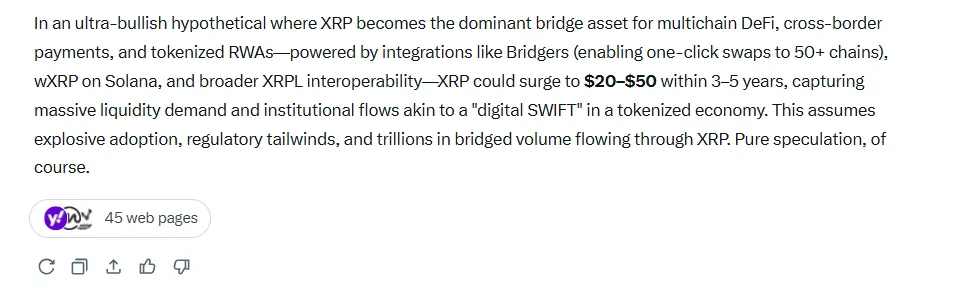
To gauge the potential impact of widespread interoperability on XRP’s price, a hypothetical scenario was posed to Grok AI, xAI’s artificial intelligence model. Assuming XRP achieves broad interoperability and becomes a leading bridge asset, Grok speculated that XRP could potentially trade between $20 and $50 within three to five years. This projection assumes strong institutional adoption, increased liquidity demand, and its establishment as a settlement layer comparable to SWIFT. However, it’s important to emphasize that this remains a purely speculative outlook, subject to numerous market variables and uncertainties. Past performance is never a guarantee of future results.
Ultimately, the push for XRP interoperability marks a pivotal moment for both Ripple and the broader crypto ecosystem. By breaking down the barriers between blockchain networks, XRP could unlock new opportunities for institutional adoption and drive significant value for its holders. Success hinges on addressing the inherent challenges of cross-chain systems and building a secure, scalable, and trustworthy infrastructure.
Related: XRP ETF Milestone Signals Positive Outlook
Source: Original article
Quick Summary
XRP is potentially evolving towards a fully connected, multi-chain ecosystem, enhancing its utility and reach across various blockchain networks. This development aligns with a broader industry trend towards interoperability, addressing the limitations of isolated blockchain environments akin to separate national economies.
Source
Information sourced from official Ripple publications, institutional research, regulatory documentation and reputable crypto news outlets.
Author
Ripple Van Winkle is a cryptocurrency analyst and founder of XRP Right Now. He has been active in the crypto space for over 8 years and has generated more than 25 million views across YouTube covering XRP daily.
Editorial Note
Opinions are the author's alone and for informational purposes only. This publication does not provide investment advice.

