










XRP payment volumes have declined even as payment counts increase, suggesting smaller average transaction sizes. Continued inflows into XRP ETFs are not immediately reflected in on-chain activity, pointing to custodial storage or passive institutional positioning.
What to Know:
- XRP payment volumes have declined even as payment counts increase, suggesting smaller average transaction sizes.
- Continued inflows into XRP ETFs are not immediately reflected in on-chain activity, pointing to custodial storage or passive institutional positioning.
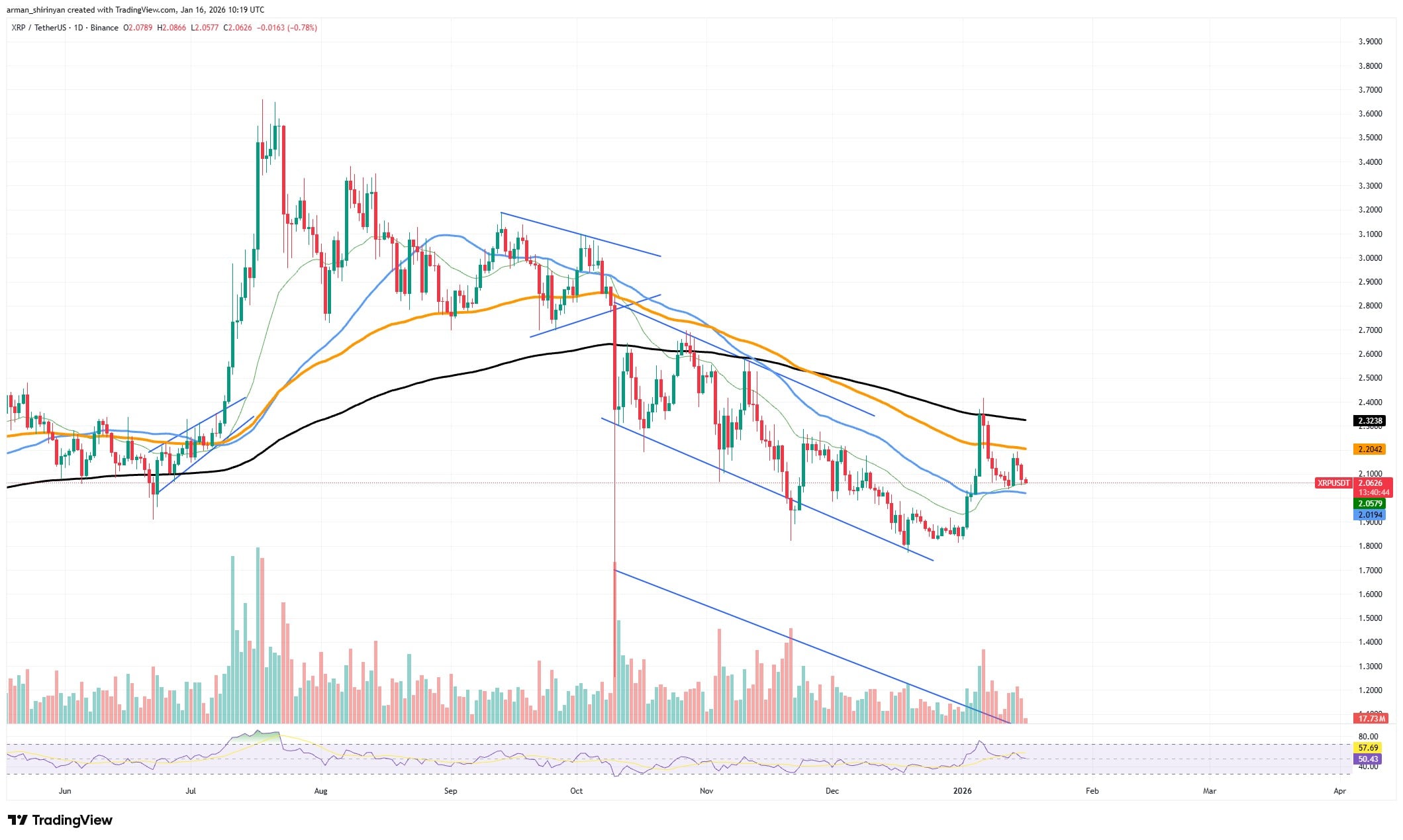
- XRP’s price action is currently neutral and brittle, with persistent resistance at the 100 EMA and a lack of follow-through volume on rebounds.
XRP presents a mixed picture for institutional investors, with on-chain data seemingly at odds with ETF inflows. While the XRP Ledger shows sustained transactional activity, the actual value being transferred has decreased significantly. This divergence raises questions about the nature of network usage and the potential disconnect between institutional interest and on-chain settlement.
On-Chain Anomaly
The primary anomaly lies in the discrepancy between the increasing number of payments and the decreasing payment volume. With only around 562 million XRP transferred in the last 24 hours, the network is showing a marked decline in value transacted compared to earlier periods of growth. This suggests a fragmentation of activity, characterized by smaller transactions and internal shuffling rather than large-scale capital flows indicative of strong conviction or aggressive positioning by major players.
This pattern contrasts with periods of heightened institutional interest, where larger, more concentrated transactions would typically be expected. The current on-chain behavior could be interpreted as cautious retail activity or utility-driven micro-movements, rather than the strategic deployment of capital by sophisticated investors. Such divergences often precede shifts in market sentiment or indicate a period of consolidation before the next major price movement.
ETF Inflows vs. On-Chain Activity
Adding to the complexity is the continued inflow of capital into XRP ETFs, suggesting sustained institutional demand. However, this demand isn’t translating into increased on-chain volume. One explanation is that XRP held within ETFs often remains in custodial structures, bypassing the need for immediate on-chain settlement. This custody abstraction means that ETF inflows do not necessarily trigger immediate activity on the XRP Ledger.
This phenomenon is not unique to XRP. The launch of Bitcoin ETFs, for example, initially saw a similar lag between ETF inflows and on-chain movements. Over time, however, increased institutional participation led to greater on-chain activity as firms began actively managing their positions and engaging in arbitrage opportunities. The timing of institutional positioning may also play a role, with firms accumulating XRP passively while awaiting more favorable market conditions or regulatory clarity.
Price Action and Market Sentiment
The hesitancy suggested by the on-chain data is reflected in XRP’s price chart, where the 100 EMA continues to act as a persistent resistance level. XRP’s inability to break above this key moving average indicates a lack of strong bullish momentum. Recent rebounds have lacked follow-through volume, and attempts to push higher have been swiftly rejected, reinforcing the notion of weak conviction among market participants.
Structurally, XRP is grinding sideways to down within a wider corrective channel, a pattern consistent with a period of consolidation and uncertainty. While there is no sign of panic selling, the absence of sustained upward momentum suggests that significant capital remains on the sidelines. This neutral-to-bearish price action underscores the importance of monitoring on-chain activity for signs of renewed institutional engagement.
Neutral but Brittle
Currently, XRP’s market position can be characterized as neutral but brittle. The declining payment volume indicates that significant capital is waiting on the sidelines, while the increasing payment counts suggest that the network is not stagnating. This delicate balance means that XRP is vulnerable to sudden price swings in either direction, depending on the next catalyst.
The key indicator to watch is whether ETF inflows eventually lead to a spot-driven repricing, which would manifest as a significant increase in on-chain volume. Such a development would signal renewed institutional conviction and could trigger a more sustained bullish trend. Until then, XRP remains in a holding pattern, awaiting a decisive shift in market sentiment or a fundamental catalyst to break through its current resistance levels.
In conclusion, the divergence between XRP’s on-chain activity and ETF inflows presents a nuanced picture for investors. While sustained institutional demand suggests long-term potential, the lack of corresponding on-chain activity and the neutral price action highlight the need for caution. Monitoring on-chain metrics for signs of increased transaction volume will be crucial in gauging the true impact of institutional investment and predicting future price movements.
Related: XRP Searches Surge: What’s Behind the Trend?
Source: Original article
Quick Summary
XRP payment volumes have declined even as payment counts increase, suggesting smaller average transaction sizes. Continued inflows into XRP ETFs are not immediately reflected in on-chain activity, pointing to custodial storage or passive institutional positioning.
Source
Information sourced from official Ripple publications, institutional research, regulatory documentation and reputable crypto news outlets.
Author
Ripple Van Winkle is a cryptocurrency analyst and founder of XRP Right Now. He has been active in the crypto space for over 8 years and has generated more than 25 million views across YouTube covering XRP daily.
Editorial Note
Opinions are the author's alone and for informational purposes only. This publication does not provide investment advice.

