








XRP is trading below a key $1.45 level, with weekly Bollinger Bands indicating increasing volatility. The 20-week moving average around $2 acts as significant resistance, hindering sustained upward price movement.
What to Know:
- XRP is trading below a key $1.45 level, with weekly Bollinger Bands indicating increasing volatility.
- The 20-week moving average around $2 acts as significant resistance, hindering sustained upward price movement.
- Failure to bounce strongly off the lower Bollinger Band suggests continued selling pressure, potentially leading to a 10% price decrease toward $1.274.
XRP’s recent price action has caught the attention of institutional investors, particularly as it flirts with critical support levels. The widening Bollinger Bands on the weekly chart suggest a period of heightened volatility, a factor that can significantly impact trading strategies and risk management. With regulatory uncertainties still looming, understanding XRP’s technical setup is crucial for informed decision-making in the digital asset space.
Bollinger Bands and Volatility
The current technical setup for XRP reveals that the price is testing the lower boundary of the weekly Bollinger Bands around $1.32. This, coupled with the bands beginning to widen, typically signals an increase in market volatility. For institutional investors, this implies a higher degree of risk and the potential for sharp price swings. Prudent risk management strategies, such as hedging or reducing exposure, may be considered during such periods. This pattern is reminiscent of previous instances where similar setups led to significant price movements, underscoring the importance of monitoring these indicators.
Resistance at the 20-Week Moving Average
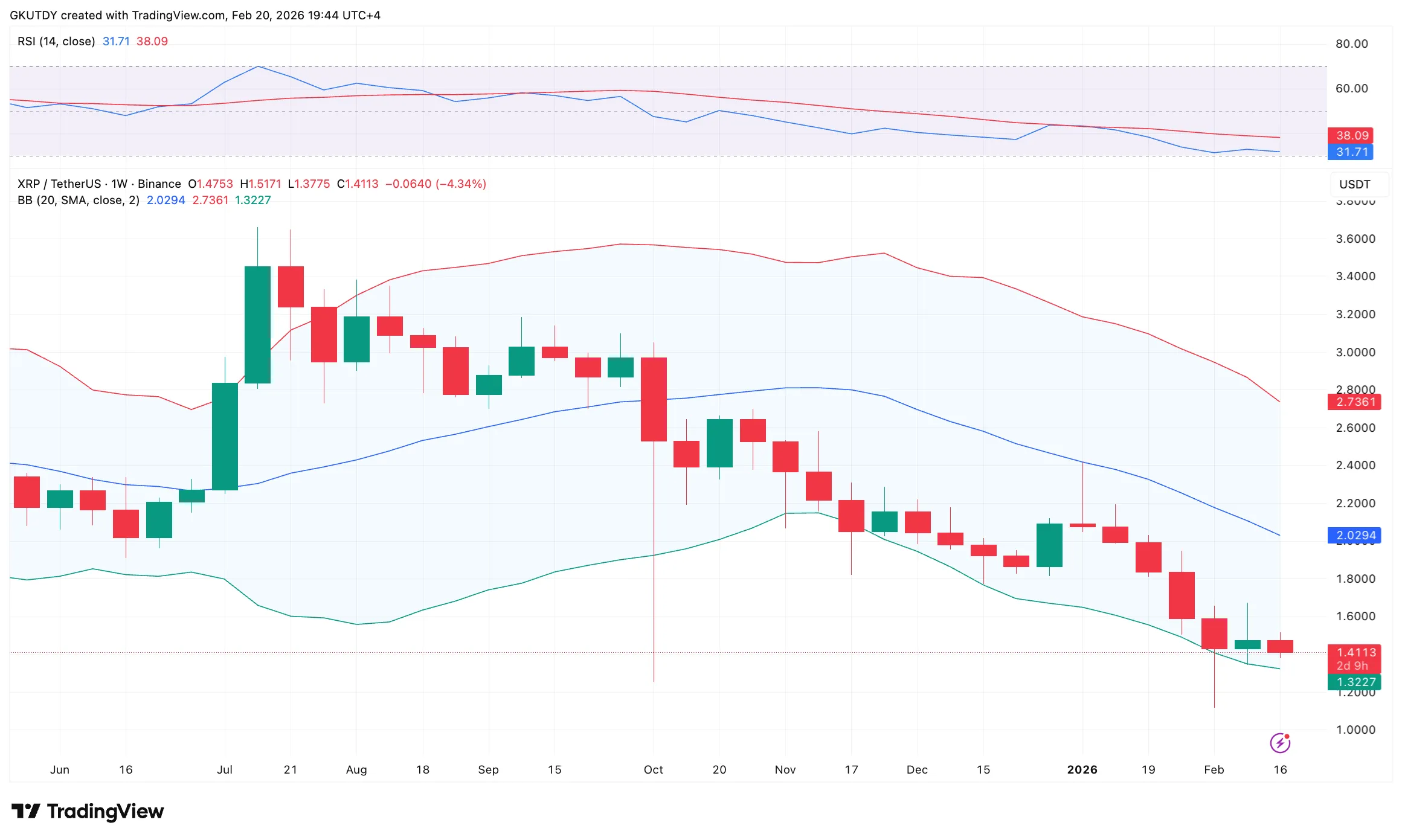
A key factor influencing XRP’s price trajectory is the 20-week moving average (MA), currently positioned near $2. This level has acted as a formidable resistance, with previous rallies failing to breach it. Institutional investors often view the 20-week MA as a critical indicator of long-term trend direction. The inability to sustain a move above this level reinforces the bearish sentiment and suggests that further downward pressure may be anticipated. Overcoming this resistance would require a significant shift in market dynamics and investor sentiment.
Price Action at the Lower Band
The behavior of XRP’s price at the lower Bollinger Band is particularly concerning. Instead of a strong bounce, the price has been consolidating with smaller weekly candles near the $1.30 level. This indicates that selling pressure remains persistent, and buyers are not stepping in with sufficient force to initiate a meaningful recovery. Such price action often precedes a more significant breakdown, as the lack of aggressive buying suggests that the market has yet to find a solid footing. Investors should closely monitor this level for any signs of capitulation, which could trigger further downside.
Potential Downside Target
Given the current technical conditions, a potential downside target for XRP lies around $1.274, roughly 10% below the current price. This level coincides with the lower Bollinger Band on the daily chart, providing a possible area of support. However, it’s crucial to recognize that support levels are not guaranteed to hold, especially in a volatile market. A breach of this level could open the door for a more substantial correction, potentially testing lower support zones. Institutional investors should prepare for this scenario by stress-testing their portfolios and adjusting their risk exposure accordingly.
Historical Context and Market Structure
Historically, XRP has exhibited similar patterns of “walking” the lower Bollinger Band on weekly charts before experiencing significant price movements. These episodes underscore the importance of understanding market structure and recognizing potential inflection points. The current setup mirrors these past occurrences, suggesting that a decisive move, either upward or downward, is likely on the horizon. Investors should analyze order book depth, trading volumes, and derivative positioning to gauge market sentiment and anticipate the direction of the next major price swing.
In conclusion, XRP’s technical outlook suggests a period of heightened risk and potential downside. The widening Bollinger Bands, resistance at the 20-week MA, and lackluster price action at the lower band all point to continued selling pressure. Prudent risk management and careful monitoring of key support levels are essential for institutional investors navigating this volatile environment. While the digital asset market is known for its rapid shifts, a disciplined approach based on technical analysis and market structure can help mitigate potential losses and capitalize on emerging opportunities.
Related: Bitcoin Buy Signals as ‘Rich Dad’ Reveals Reasons
Source: Original article
Quick Summary
XRP is trading below a key $1.45 level, with weekly Bollinger Bands indicating increasing volatility. The 20-week moving average around $2 acts as significant resistance, hindering sustained upward price movement.
Source
Information sourced from official Ripple publications, institutional research, regulatory documentation and reputable crypto news outlets.
Author
Ripple Van Winkle is a cryptocurrency analyst and founder of XRP Right Now. He has been active in the crypto space for over 8 years and has generated more than 25 million views across YouTube covering XRP daily.
Editorial Note
Opinions are the author's alone and for informational purposes only. This publication does not provide investment advice.

