






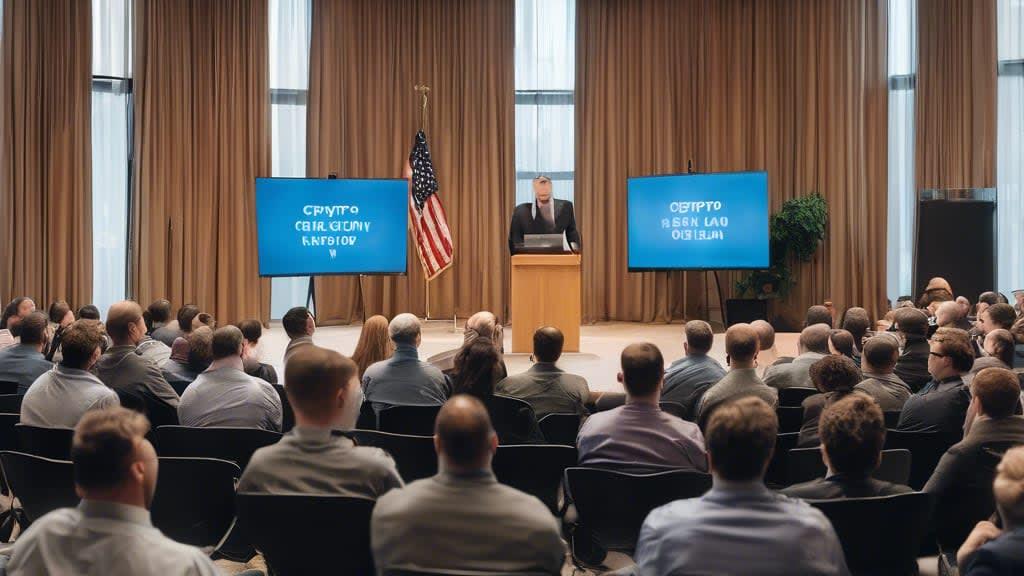

The focus keyword writing code is central to recent comments by a U.S. Department of Justice (DOJ) official designed to reassure crypto software developers.
The focus keyword writing code is central to recent comments by a U.S. Department of Justice (DOJ) official aiming to reassure crypto software developers. Speaking at a crypto-focused gathering in Wyoming, DOJ Acting Assistant Attorney General Matthew Galeotti stated that creating code without criminal intent should not be treated as a punishable offense.
DOJ Clarifies Its Position on Crypto Developers
Galeotti addressed growing concerns within the digital asset developer community, particularly following recent high-profile cases where developers were convicted under money laundering statutes. His remarks, delivered at an event organized by the newly formed American Innovation Project (AIP), were met with enthusiastic applause as he emphasized that the DOJ does not intend to prosecute individuals solely for writing code that functions neutrally in the digital ecosystem.
“The department will not use federal criminal statutes to impose de facto regulation on the digital asset space,” said Galeotti. He stressed that the DOJ would not use indictments as substitutes for lawmaking, nor force innovators to second-guess what actions might land them in legal trouble.
Most notably, Galeotti clarified, “Merely writing code without ill intent is not a crime.”
Recent Legal Actions Spark Developer Concerns
These statements come in the wake of recent courtroom developments that sent shockwaves through the crypto development space. Roman Storm, a developer behind Tornado Cash, was found guilty of orchestrating an unlicensed money-transmitting enterprise. Similarly, developers of the privacy-focused Samourai Wallet pleaded guilty to conspiracy charges involving unlicensed money transmission.
Addressing these specific legal frameworks, Galeotti explained that prosecutors would refrain from invoking the relevant statute unless there’s concrete evidence that the accused knowingly disregarded legal boundaries. According to him, no charges would be pursued in cases involving decentralized platforms that solely enable peer-to-peer transactions and do not involve third-party custody of user funds.
Policy Changes and Regulatory Direction
Earlier this year, DOJ Deputy Attorney General Todd Blanche released a policy memo outlining a pivot in regulatory stance. Initiated under the Trump administration’s appointees, the new approach called for a more measured evaluation of digital asset cases. The memo also confirmed the disbanding of the DOJ’s National Cryptocurrency Enforcement Team, a move interpreted by many as a sign of regulatory de-escalation.
Despite these policy guidelines, some regional offices like the Southern District of New York have continued to aggressively pursue legal action against crypto developers, further stoking fears across the developer community.
Developer Protections and Industry Advocacy
Galeotti reiterated a central principle: Software creators should not be penalized for how others choose to use their creations. “If a third party misuses a tool in violation of the law, they—not the innocent developer—should face prosecution,” he affirmed during his speech at the AIP’s inaugural event, a group that aims to educate policymakers about blockchain and digital assets. Launched this week, AIP enters an already crowded advocacy space, but it appears positioned to make significant early impressions.
Amanda Tuminelli, executive director of the DeFi Education Fund, responded positively to the DOJ’s articulated stance. “The fact that the DOJ acknowledged that software developers should not be held responsible for third parties’ misuse of their code affirms what we have been advocating for years,” she said. “Let’s celebrate this as a moment of progress and remember that there is still more work to be done to change the law permanently.”
The cryptocurrency industry’s ongoing efforts to safeguard developers are also reflected in pending legislation. While the exact language is still subject to Senate approval, current crypto market structure bills feature clauses designed to protect those building decentralized technology from undue legal exposure.
As the boundaries between regulation and innovation continue to evolve, Galeotti’s remarks mark a significant moment of clarity in the broader legal outlook facing developers in the blockchain space.
Related: XRP Signals Potential Rally to $10
Read More: DOJ Axes Crypto Unit as Trump’s Regulatory Pullback Continues
Quick Summary
The focus keyword writing code is central to recent comments by a U.S. Department of Justice (DOJ) official aiming to reassure crypto software developers. Speaking at a crypto-focused gathering in Wyoming, DOJ Acting Assistant Attorney General Matthew Galeotti stated that creating code without criminal intent should not be treated as a punishable offense.
Source
Information sourced from official Ripple publications, institutional research, regulatory documentation and reputable crypto news outlets.
Author
Ripple Van Winkle is a cryptocurrency analyst and founder of XRP Right Now. He has been active in the crypto space for over 8 years and has generated more than 25 million views across YouTube covering XRP daily.
Editorial Note
Opinions are the author's alone and for informational purposes only. This publication does not provide investment advice.

