








XLM price slipped in a volatile session, falling nearly 2% as heavy selloffs dragged the token lower across crypto markets. Stellar’s native cryptocurrency dropped from $0.41 to approximately $0.40 over the past 24 hours amid intensified trading volumes and shaky investor sentiment.
XLM price slipped in a volatile session, falling nearly 2% as heavy selloffs dragged the token lower across crypto markets. Stellar’s native cryptocurrency dropped from $0.41 to approximately $0.40 over the past 24 hours amid intensified trading volumes and shaky investor sentiment. The trading action sent shockwaves through altcoins, even as bitcoin hovered near $115,000.
Volatility increased sharply after 03:00 UTC on August 19, causing a rapid spike in activity. Trading volume surged to 52.17 million — more than double the daily average — signaling aggressive sell pressure at key resistance levels. With resistance now forming firmly at $0.41, bulls are left defending a thinning support range between $0.403 and $0.405.
Sharp Decline Highlights Weakening Support Levels
Midday trading further exacerbated XLM’s drop. Between 13:25 and 14:24 UTC, the coin slid from $0.407 to $0.403, with the heaviest selling concentrated in a 16-minute window. During that period, XLM fell from $0.410 to $0.404 on unusually high per-minute volume. This development not only reinforced resistance at $0.410, but also left the $0.403–0.405 support zone increasingly fragile.
Though Stellar has received positive recognition in institutional circles — including recent investment activity via its backing of digital securities exchange Archax — ongoing macroeconomic pressures and bearish altcoin momentum continue to weigh on sentiment. Any breakdown below the $0.403 mark could open the path to deeper losses.
How Volume and Resistance Are Shaping Short-Term Outlook
Traders observing XLM should note the significance of recent volume behavior. After the initial surge in trading activity, subsequent sessions saw volume taper off — a possible sign that buying interest is waning. Without fresh support, this change may indicate that the path of least resistance remains to the downside unless technical indicators suggest stabilization.
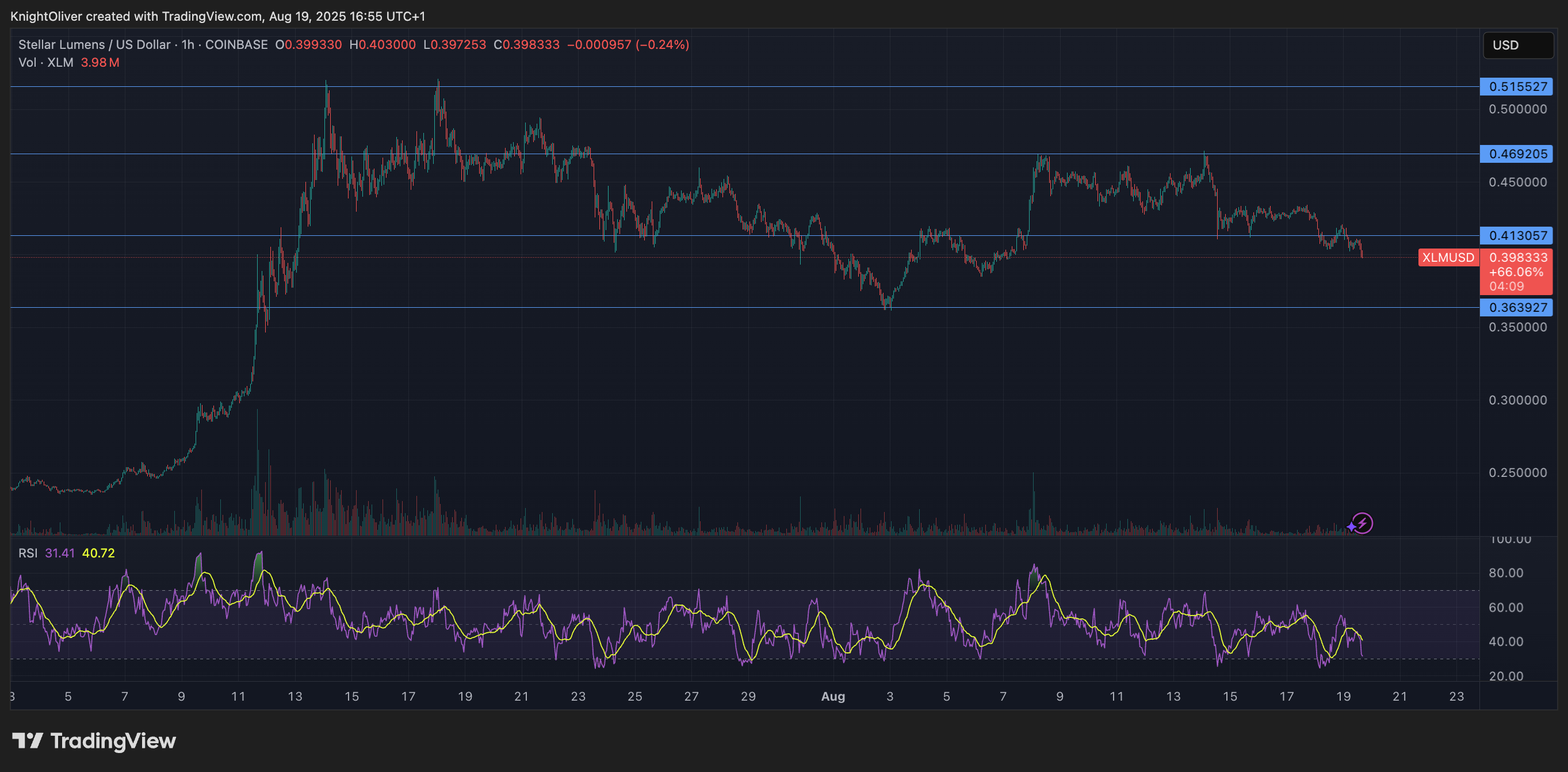
Chart showing XLM’s trading activity, highlighting key resistance and support levels.
Key Technical Signals to Watch
- XLM’s trading volume hit 52.17 million during the drop — 105% higher than the 24-hour average.
- The $0.41 level acted as strong resistance following multiple price rejection attempts.
- The $0.403–$0.405 zone remains the last meaningful layer of support.
- Secondary resistance has emerged around $0.418–$0.420, based on repeated failures to break this range.
- Volume is currently falling below average, which could indicate weakening bullish sentiment.
- Monitoring the $0.403 level is crucial; a confirmed break below could accelerate the downtrend.
XLM’s current trajectory reflects broader market consolidation, and its price vulnerability makes the $0.403 threshold especially critical. If buyers retreat further, a bearish continuation could align XLM with the overall downward trend gripping the altcoin sector.
Related: Bitcoin Maintains Price; Ethereum Hits High
Disclaimer: Portions of this content were created with assistance from AI tools and reviewed by editors in line with our standards. Learn more in CoinDesk’s full AI policy.
Quick Summary
XLM price slipped in a volatile session, falling nearly 2% as heavy selloffs dragged the token lower across crypto markets. Stellar’s native cryptocurrency dropped from $0.41 to approximately $0.40 over the past 24 hours amid intensified trading volumes and shaky investor sentiment.
Source
Information sourced from official Ripple publications, institutional research, regulatory documentation and reputable crypto news outlets.
Author
Ripple Van Winkle is a cryptocurrency analyst and founder of XRP Right Now. He has been active in the crypto space for over 8 years and has generated more than 25 million views across YouTube covering XRP daily.
Editorial Note
Opinions are the author's alone and for informational purposes only. This publication does not provide investment advice.

