








Ripple’s XRP Ledger (XRPL) sees a major infrastructure upgrade with the first full specification of its Payment Engine, potentially enhancing reliability for institutional use.
What to Know:
- Ripple’s XRP Ledger (XRPL) sees a major infrastructure upgrade with the first full specification of its Payment Engine, potentially enhancing reliability for institutional use.
- Shiba Inu (SHIB) is approaching a critical support level, reminiscent of a previous market downturn, which could determine its short-term trajectory.
- Bitcoin’s (BTC) current positioning below a key Bollinger Band on the monthly chart suggests a possible retest of lower levels if it cannot reclaim key resistance.
Bitcoin and the broader crypto market are at an interesting juncture. Lingering macro uncertainty combined with specific technical developments across assets like XRP and SHIB create a mixed outlook. Institutional investors are closely watching these dynamics to gauge potential entry points and manage risk.
XRPL Payment Engine Specification
Common Prefix has released the first comprehensive specification of the XRPL Payment Engine, a core component of Ripple’s ecosystem. This documentation details the engine’s functionalities, including pathfinding, payment execution, and multi-currency support. Ripple CTO David Schwartz responded with a “Wow!” signaling the importance of the upgrade.
This development addresses a key concern for institutional adoption: the need for robust and transparent infrastructure. Formal specification and verification of critical systems like the Payment Engine can significantly reduce operational risk and improve reliability. In traditional finance, such documentation is standard practice, so this brings XRP closer to institutional standards.
SHIB Tests Key Support
Shiba Inu (SHIB) is currently trading around $0.0000075, edging closer to a critical support level at $0.00000678. This level is tied to a previous “Black Friday” market flush, making it a significant psychological and technical threshold. A break below this level could trigger further downside, while a hold could signal a potential rebound.
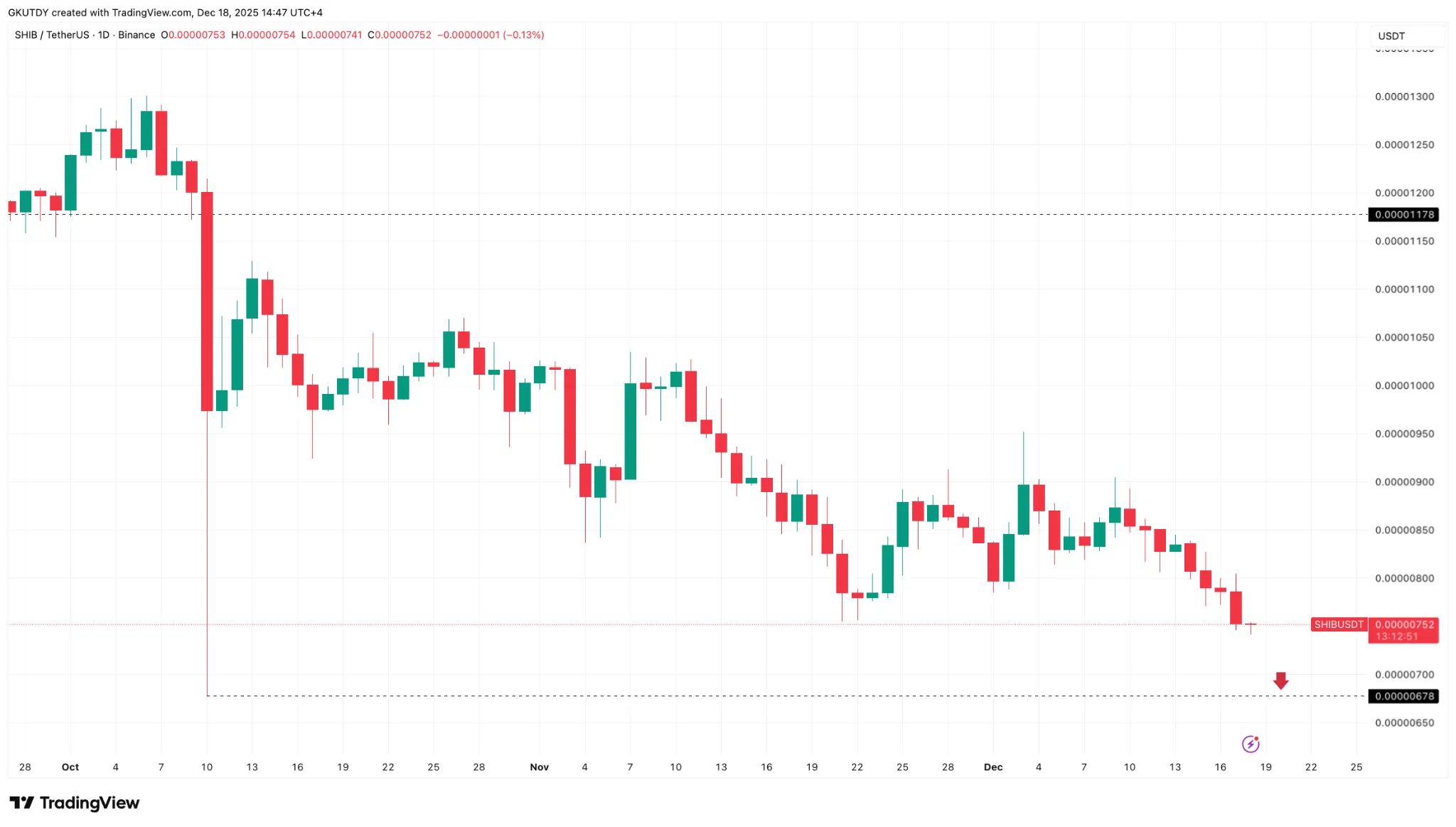
For institutional investors, SHIB represents a highly speculative asset. Its price action is largely driven by retail sentiment and social media trends, making it difficult to analyze using traditional valuation metrics. However, the approaching support level could present a short-term trading opportunity for those with a high-risk tolerance, while others may see it as a warning sign of broader market fragility.
Bitcoin’s Bollinger Band Positioning
Bitcoin’s monthly chart shows the price currently around $87,283, below the mid-Bollinger Band at approximately $88,903. This positioning suggests a bearish bias, with the lower Bollinger Band at $52,256 acting as a potential downside target. The ability of Bitcoin to reclaim and hold above the mid-band will be crucial in determining its next move.
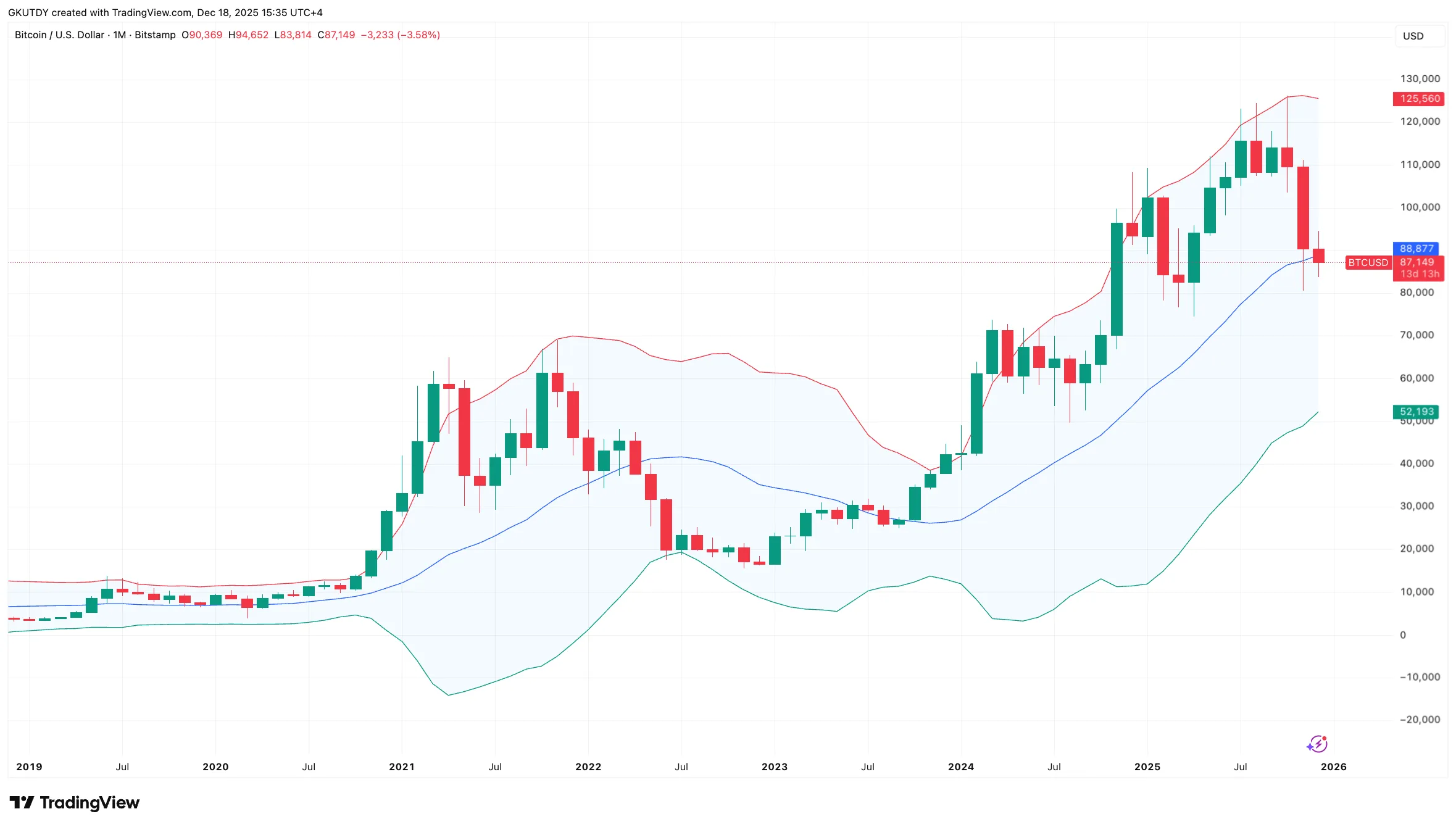
Bollinger Bands are a widely used technical indicator that can help identify potential areas of support and resistance. Bitcoin’s current positioning below the mid-band is a concern, but it is important to remember that these bands are dynamic and can adjust based on market volatility. A sustained move above $88,903 could negate the bearish signal and open the door for further upside.
Key Levels to Watch
The short-term outlook hinges on the market’s ability to defend key support levels. For Bitcoin, $80,600 and $74,110 are critical levels to watch, with a more significant downside target at $52,256. XRP needs to maintain above recent daily lows to avoid another leg down, while SHIB’s fate may depend on whether it can hold the $0.00000678 level.
These levels are not arbitrary; they represent areas where buyers have previously stepped in to support the market. A failure to hold these levels could trigger cascading liquidations and accelerate the downside momentum. Conversely, a successful defense could provide a foundation for a potential recovery.
Regulatory and Macro Considerations
Beyond the technical analysis, regulatory developments and macroeconomic conditions continue to play a significant role in shaping the crypto market’s trajectory. The ongoing debate around ETF approvals, the evolving regulatory landscape in the US and Europe, and the potential for further interest rate hikes by the Federal Reserve all contribute to the overall uncertainty.
Institutional investors are closely monitoring these factors to assess the long-term viability of the crypto market. Clear and consistent regulatory frameworks are essential for attracting institutional capital, while a stable macroeconomic environment can provide a more predictable backdrop for investment decisions. The interplay between these factors and the technical developments discussed above will ultimately determine the market’s direction.
In conclusion, the crypto market is currently at a crossroads, with key assets like XRP, SHIB, and Bitcoin facing critical tests. While the XRPL Payment Engine upgrade is a positive sign for institutional adoption, the technical outlook for SHIB and Bitcoin suggests potential downside risks. Investors should closely monitor these developments and remain vigilant in managing their risk exposure.
Related: Bitcoin Hype Plunges: Market Signals Rejection
Source: Original article
Quick Summary
Ripple’s XRP Ledger (XRPL) sees a major infrastructure upgrade with the first full specification of its Payment Engine, potentially enhancing reliability for institutional use. Shiba Inu (SHIB) is approaching a critical support level, reminiscent of a previous market downturn, which could determine its short-term trajectory.
Source
Information sourced from official Ripple publications, institutional research, regulatory documentation and reputable crypto news outlets.
Author
Ripple Van Winkle is a cryptocurrency analyst and founder of XRP Right Now. He has been active in the crypto space for over 8 years and has generated more than 25 million views across YouTube covering XRP daily.
Editorial Note
Opinions are the author's alone and for informational purposes only. This publication does not provide investment advice.

