






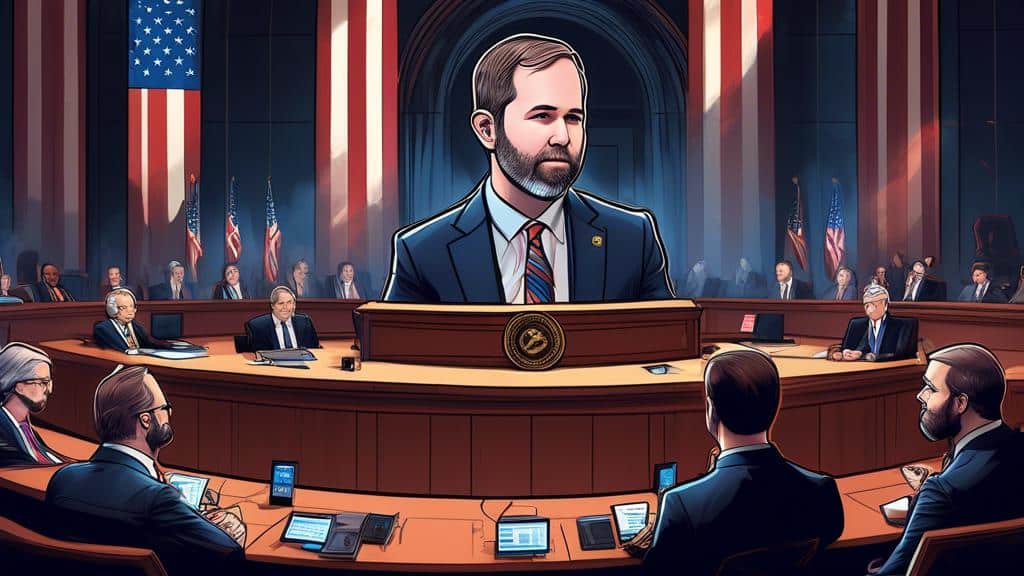

XRP continues to stand at the center of regulatory discussions in the U.S. as Ripple CEO Brad Garlinghouse is set to testify before the Senate Banking Committee. This hearing, focused on the proposed crypto market structure legislation, comes at a critical juncture for the crypto industry seeking clearer regulation.
XRP continues to stand at the center of regulatory discussions in the U.S. as Ripple CEO Brad Garlinghouse is set to testify before the Senate Banking Committee. This hearing, focused on the proposed crypto market structure legislation, comes at a critical juncture for the crypto industry seeking clearer regulation.
The Senate Banking Committee has officially scheduled a comprehensive hearing to evaluate a new legislative proposal aimed at clarifying the regulatory framework for digital assets. The hearing is slated for Wednesday, July 9, at 10 a.m. ET, as confirmed by Eleanor Terrett, host of the Crypto in America media outlet.
The legislation, introduced last month by Republican Senators Tim Scott, Cynthia Lummis, Bill Hagerty, and Thom Tillis, seeks to remove ambiguity around crypto regulation. Specifically, it aims to define whether digital tokens fall under the jurisdiction of the Securities and Exchange Commission (SEC) or the Commodity Futures Trading Commission (CFTC), based on their classification as securities or commodities. Read more about the bill here.
Brad Garlinghouse will represent Ripple as a witness during the hearing. Joining him will be other leading figures in the blockchain and digital asset ecosystem, including Summer Mersinger from the Blockchain Association, Chainalysis CEO Jonathan Levin, and Dan Robinson of Paradigm.
Garlinghouse’s upcoming testimony is seen by many as especially significant. Attorney John Deaton has pointed out that Ripple and XRP are prime examples of how inconsistent U.S. regulatory treatment can be for cryptocurrencies. These inconsistencies stretch back more than a decade.
According to Deaton, Ripple engaged with key financial regulators as early as 2013, including meetings with the Federal Reserve, SEC, and U.S. Treasury to explain the workings of XRP and the XRP Ledger (XRPL). A year later in 2014, the U.S. Government Accountability Office labeled XRP a virtual currency. In 2015, Ripple reached a settlement with FinCEN and agreed to comply with banking laws, paying $700 million in fines linked to a transaction with Roger Ver.
Notably, Deaton mentioned that both the SEC and FinCEN had an information-sharing agreement in place, granting the SEC extensive access to Ripple’s data. In 2018, SEC enforcement attorneys even conducted an internal Howey test on XRP but ultimately decided against recommending enforcement action—this was later highlighted by Judge Analisa Torres during legal proceedings involving Ripple.
Later that same year, Ripple executives—including Garlinghouse—met with the SEC to seek clarity on XRP’s status. This happened shortly after the agency issued favorable remarks about Bitcoin and Ethereum through the now-controversial Hinman speech. During this meeting, the SEC did not convey any concerns regarding securities violations despite being fully informed about XRP’s operations and market presence.
Further supporting the argument for regulatory inconsistency, a 2019 Financial Stability Oversight Council (FSOC) report—co-signed by both SEC and CFTC heads—categorized XRP as a virtual currency. That same year, Coinbase informed the SEC of its plans to list XRP on its platform after conducting its own legal review. The SEC raised no objections, leading Coinbase to list XRP and promote its use in international settlements alongside the stablecoin USDC.
Additionally, in June 2019, MoneyGram revealed in an SEC filing its intention to utilize XRP for cross-border payments. Though the SEC was aware that MoneyGram would be selling XRP on secondary markets, no objections were raised.
Despite XRP’s global trading footprint across more than 200 exchanges and several foreign regulators formally recognizing it as a non-security asset, the SEC moved forward with a lawsuit against Ripple in December 2020. The suit alleges that XRP has functioned as a security in every transaction dating back to 2013. More details on the case’s current status can be found here.
John Deaton has emphatically stated that despite various U.S. agencies labeling XRP as a currency, the SEC continued targeting Ripple with enforcement actions. This regulatory disconnect underscores the urgency for consistent and clear guidelines—an issue Garlinghouse hopes to address during his Senate testimony.
Related: Expert Advice: Sell XRP If You’re Confused
His appearance before the Senate could galvanize lawmakers into establishing long-awaited clarity on crypto regulations, particularly for projects like XRP that sit at the center of regulatory ambiguity.
Quick Summary
XRP continues to stand at the center of regulatory discussions in the U.S. as Ripple CEO Brad Garlinghouse is set to testify before the Senate Banking Committee. This hearing, focused on the proposed crypto market structure legislation, comes at a critical juncture for the crypto industry seeking clearer regulation.
Source
Information sourced from official Ripple publications, institutional research, regulatory documentation and reputable crypto news outlets.
Author
Ripple Van Winkle is a cryptocurrency analyst and founder of XRP Right Now. He has been active in the crypto space for over 8 years and has generated more than 25 million views across YouTube covering XRP daily.
Editorial Note
Opinions are the author's alone and for informational purposes only. This publication does not provide investment advice.

