








Shiba Inu (SHIB) shows signs of bottoming out, with decreasing selling pressure and stabilization near local lows, suggesting potential for a relief rally.
What to Know:
- Shiba Inu (SHIB) shows signs of bottoming out, with decreasing selling pressure and stabilization near local lows, suggesting potential for a relief rally.
- XRP is transitioning from decline to recovery, with stabilization at the lower end of its descending channel, hinting at a possible directional change and improved risk-reward profile.
- Bitcoin’s (BTC) price stabilization amid declining volume raises concerns about weak conviction and potential for abrupt fluctuations, though seasonal effects may contribute to the volume contraction.
The digital asset market navigates a period of holiday lull, with low volatility and calm volumes. However, beneath the surface, individual assets like Shiba Inu, XRP, and Bitcoin exhibit distinct patterns that offer clues about their potential trajectories in the coming year. Institutional investors are closely monitoring these nuances to position themselves for the next wave of market activity.
Shiba Inu’s Exhausted Decline
Shiba Inu (SHIB) has been in a downtrend for weeks, pushing momentum indicators into oversold territory. While the decline appears severe, the context reveals a market where sellers have been gradually exhausting themselves. The stabilization near local lows, coupled with smaller green candles emerging, suggests that weak hands have largely exited the market, a common precursor to a trend reversal.
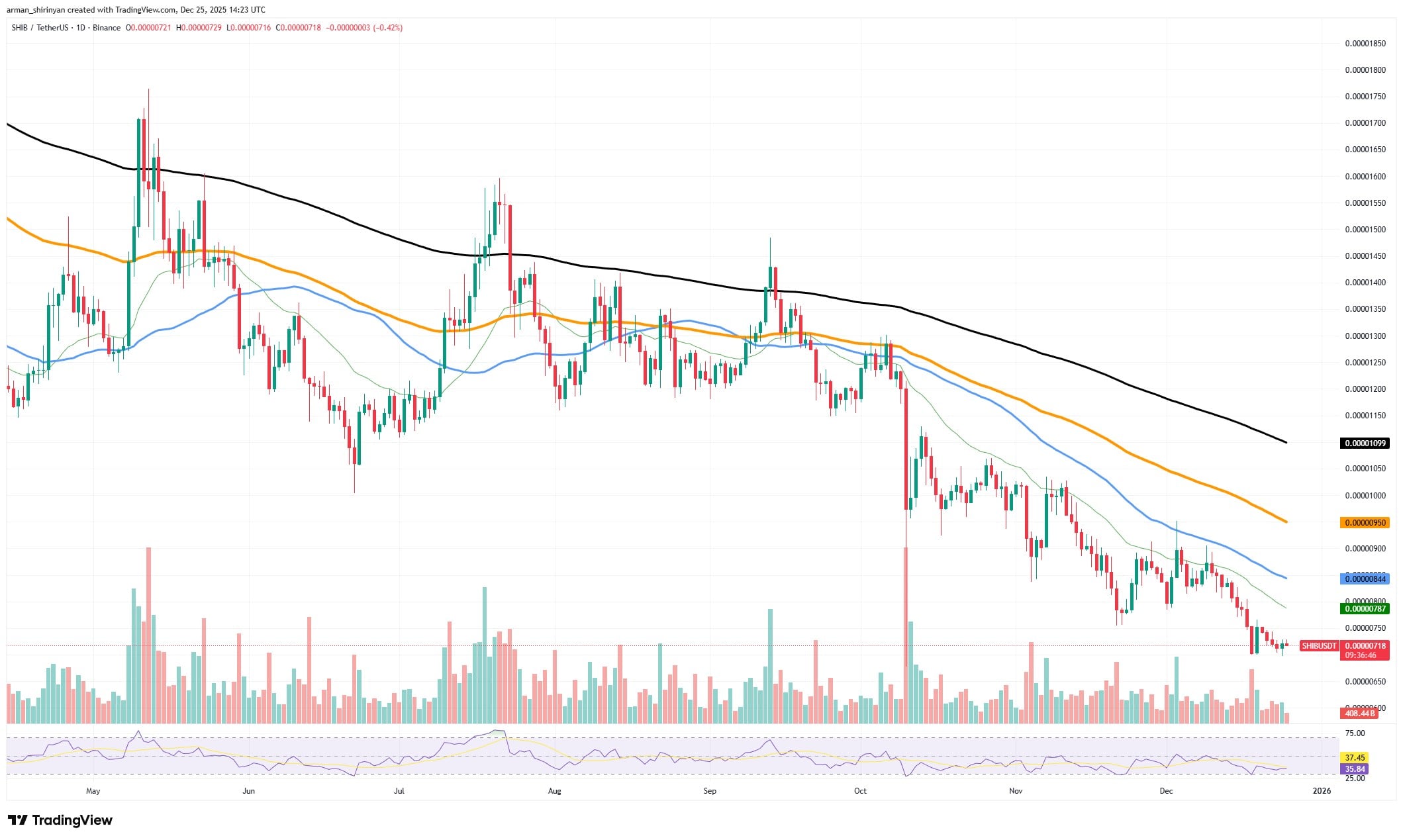
The lack of significant volume increase during the recent leg lower supports the exhaustion theory. While a full recovery isn’t yet confirmed, the risk-reward ratio for short positions has deteriorated, making carefully managed long positions more appealing at these levels. This dynamic mirrors past instances where oversold conditions led to brief relief rallies, offering opportunities for nimble traders.
XRP’s Quiet Recovery
XRP is subtly shifting from survival to recovery, displaying early signs that the downward cycle is losing steam. This transition is marked by stabilization along the lower edge of its descending channel, with rebounds becoming more frequent and new lows only marginal. This behavior often indicates that sellers are running out of steam, and downside liquidity is drying up.
The muted yet non-collapsing Relative Strength Index (RSI) further supports this view, suggesting that selling pressure is being absorbed rather than amplified. As seen in prior crypto bottoms, the shift from panic selling to quiet accumulation is a constructive development. While XRP remains below key moving averages, a sentiment shift could trigger a swift recovery, especially given the reduced overhead resistance compared to the distribution phase.
Bitcoin’s Volume Conundrum
Bitcoin’s current state presents a mixed picture, with price stabilization juxtaposed against declining volume. This divergence raises concerns about the strength of the current market structure. Typically, healthy trends, particularly near potential reversals, see price and volume move in tandem, reflecting strong conviction among market participants.
The consolidation of Bitcoin within a narrow range near local lows, without a corresponding increase in volume, suggests a market that is becoming quieter rather than displaying accumulation through broader participation. This creates a brittle environment where even slight selling pressure could trigger abrupt price swings. This dynamic is reminiscent of previous periods where low-volume consolidation preceded sharp corrections, underscoring the need for caution.
Seasonal Liquidity Effects
However, the timing of this volume contraction coincides with the holiday season, a period typically characterized by reduced liquidity across all markets. Institutional desks slow down, and retail activity wanes, leading to a general reluctance to make significant capital commitments. This seasonal effect could be masking underlying strength or weakness in Bitcoin’s market structure.
Historically, Bitcoin has shown sensitivity to liquidity cycles, with periods of low volume often followed by increased volatility once regular trading conditions resume. Therefore, it’s crucial to distinguish between technical flaws and temporary distortions caused by seasonal factors. The true test will come when participation recovers along with price, confirming the next significant move.
Regulatory Posture and Institutional Flows
The regulatory environment continues to cast a long shadow over digital assets. Recent enforcement actions and policy pronouncements have created uncertainty, impacting institutional flows and market sentiment. Clarity on regulatory frameworks is essential for fostering long-term adoption and attracting sustained investment from traditional financial institutions.
The potential for spot Bitcoin ETFs to gain approval remains a key catalyst. The launch of Bitcoin futures ETFs in 2021 triggered a significant influx of capital, and a spot ETF could have an even more profound impact by providing easier access for a wider range of investors. However, regulatory hurdles and market structure considerations continue to pose challenges.
Related: XRP Quantum-Safe Signatures Replace Elliptic Curves
Source: Original article
Quick Summary
Shiba Inu (SHIB) shows signs of bottoming out, with decreasing selling pressure and stabilization near local lows, suggesting potential for a relief rally. XRP is transitioning from decline to recovery, with stabilization at the lower end of its descending channel, hinting at a possible directional change and improved risk-reward profile.
Source
Information sourced from official Ripple publications, institutional research, regulatory documentation and reputable crypto news outlets.
Author
Ripple Van Winkle is a cryptocurrency analyst and founder of XRP Right Now. He has been active in the crypto space for over 8 years and has generated more than 25 million views across YouTube covering XRP daily.
Editorial Note
Opinions are the author's alone and for informational purposes only. This publication does not provide investment advice.

