








XRP’s price action is showing similarities to its January 2025 breakout, suggesting a potential 40% increase if resistance levels continue to break. Ethereum’s stability around the $3,000-$3,100 range is structurally weak, with a risk of decline if it loses the $3,100 support level.
What to Know:
- XRP’s price action is showing similarities to its January 2025 breakout, suggesting a potential 40% increase if resistance levels continue to break.
- Ethereum’s stability around the $3,000-$3,100 range is structurally weak, with a risk of decline if it loses the $3,100 support level.
- Bitcoin’s recent comeback may be riskier than it appears, with potential for a price drop as institutional liquidity returns and reintroduces supply to the market.
XRP, Ethereum, and Bitcoin are at critical junctures, presenting both opportunities and risks for institutional investors. XRP is showing bullish signals reminiscent of its early 2025 surge, while Ethereum’s apparent stability masks underlying structural weaknesses. Bitcoin’s recent rally, fueled by low-liquidity conditions, could be a trap as institutional players return to the market. Understanding these nuances is crucial for navigating the digital asset landscape.
XRP’s Déjà Vu Moment
The current price structure of XRP is drawing parallels to January 2025, a period that preceded a 40% surge. After a decline, XRP consolidated sideways, with volume drying up and volatility shrinking. This pattern of indecision resolved to the upside as selling pressure waned and buyers stepped in.
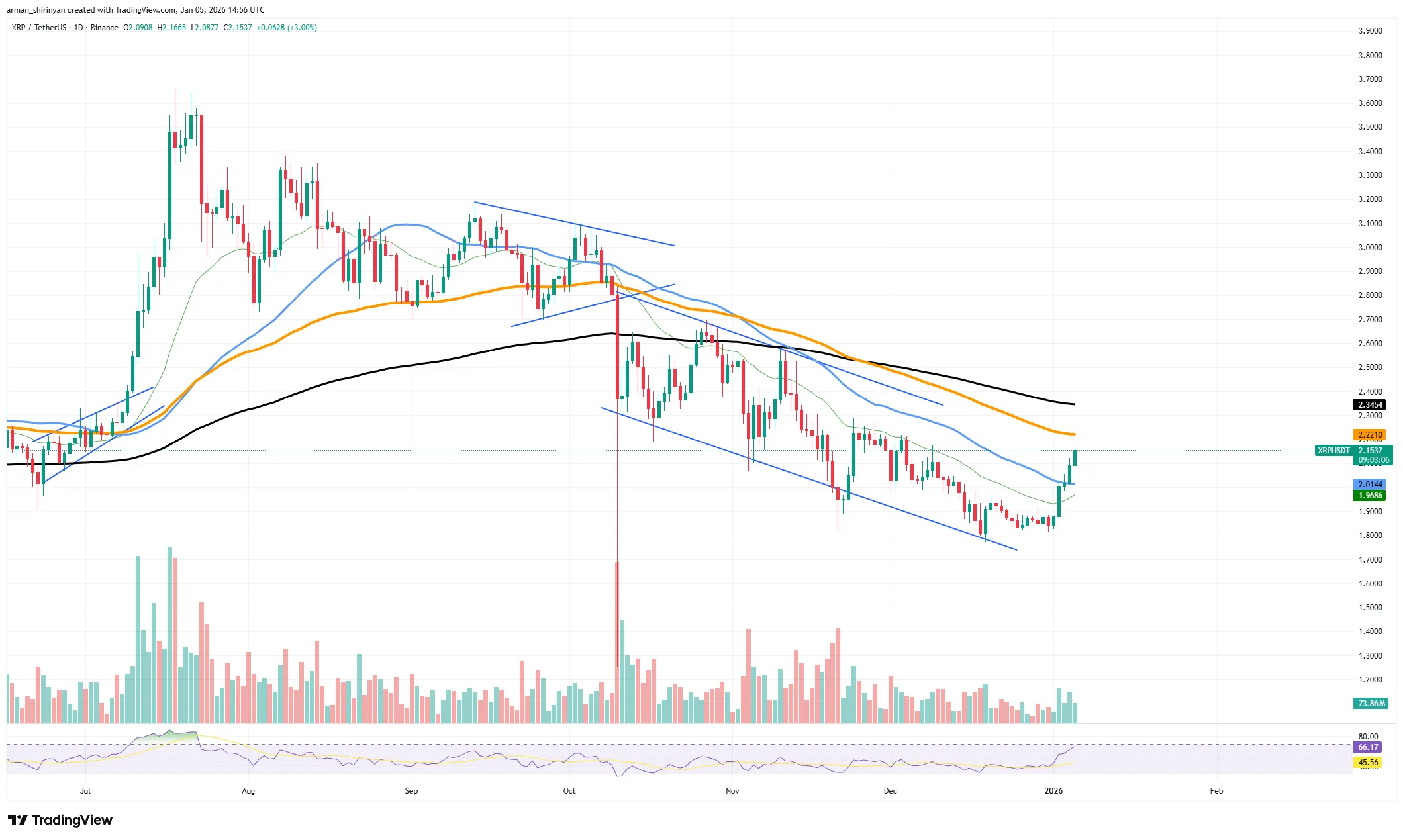
The breakout from a declining channel, coupled with a pause for consolidation, reinforces the bullish outlook. Momentum indicators like RSI have moved into bullish territory without becoming overextended, and volume is growing steadily, indicating genuine participation rather than speculative frenzy. If XRP can sustain this momentum and break through resistance levels, a repeat of the 2025 surge is plausible.
Ethereum’s Unstable Equilibrium
Ethereum’s trading range between $3,000 and $3,100 appears stable on the surface but is structurally unstable. Following a robust advance, Ethereum entered a corrective phase with lower highs and intense movement around its moving averages. Rebounds have been shallow, and upside attempts have struggled to gain traction, suggesting a lack of buyer confidence.
Technically, Ethereum remains trapped below key long- and medium-term moving averages, which act as dynamic resistance. While ETH has held near $3,000, it has not shown strong performance above this level. Momentum indicators support this ambiguity, with RSI recovering from oversold conditions but not reaching levels indicative of a strong trend continuation. Investors should be wary of a potential decline if Ethereum loses the $3,100 support.
Bitcoin’s Fleeting Optimism
Bitcoin’s recent comeback has rekindled optimism, but the timing may be precarious. Bitcoin often rises with little resistance during periods of lower participation, such as holidays or low-liquidity sessions. However, this optimism may be short-lived as liquidity returns to normal.
Institutions typically rebalance hedges or reduce exposure when they reengage after slower periods, reintroducing supply to the market. This activity can quickly reverse sentiment, especially as retail traders respond to recent upside and positive narratives. Bitcoin is still trading below significant long-term resistance zones, and the overall structure remains vulnerable. Increased volume, often interpreted as accumulation, may actually indicate distribution, with stronger hands using liquidity to sell earlier lower-priced positions.
Market Psychology and Liquidity Dynamics
Prolonged consolidation often leads to complacency, as seen in XRP’s setup before its 2025 breakout. Traders who waited for confirmation are compelled to chase the price higher, and short positions quickly unwind. This dynamic can drive significant price movements, as sidelined capital pours in.
In contrast, Ethereum’s current balance is more about expectations than strength. Support levels can seem stable until they are not, and a break below $3,100 could trigger stop orders and sidelined sellers, accelerating the decline. Bitcoin’s history is littered with instances where confidence following relief rallies was punished. Without sustained institutional demand and a clear reclaim of key resistance, the current move risks becoming another trap.
The Role of Derivatives and ETF Mechanics
Derivatives positioning and ETF mechanics play a crucial role in shaping these market dynamics. The unwinding of short positions in XRP, driven by the breakout above key moving averages, can amplify the upward momentum. Conversely, the lack of strong performance above $3,000 in Ethereum suggests that call options may be losing value, leading to a reduction in hedging activity and increased vulnerability to downside risk.
Bitcoin ETFs, while providing increased access for institutional investors, also introduce new dynamics. The flow of funds into and out of these ETFs can significantly impact Bitcoin’s price, and rebalancing activity by ETF providers can exacerbate market volatility. Understanding these factors is essential for gauging the true strength of Bitcoin’s recent rally.
Regulatory Posture and Macro Cycles
The regulatory posture and macro cycles also exert influence. Favorable regulatory developments for XRP could further fuel its bullish momentum, while increased regulatory scrutiny could dampen enthusiasm. Similarly, shifts in macro conditions, such as changes in interest rates or inflation expectations, can impact the risk appetite of institutional investors and their allocation to digital assets.
For Ethereum, regulatory uncertainty surrounding its classification as a security could weigh on its price, while a more favorable regulatory environment could unlock new opportunities. Bitcoin, as the most established digital asset, is often seen as a hedge against macroeconomic uncertainty, but it is not immune to the effects of tighter monetary policy or increased risk aversion.
In conclusion, XRP, Ethereum, and Bitcoin present distinct scenarios for institutional investors. XRP’s bullish setup offers potential gains, while Ethereum’s instability demands caution, and Bitcoin’s rally requires a discerning eye. Navigating these markets requires a deep understanding of market structure, liquidity dynamics, derivatives positioning, and the broader regulatory and macro landscape.
Related: Bitcoin Climbs: Signals Positive Crypto ETF Flows
Source: Original article
Quick Summary
XRP’s price action is showing similarities to its January 2025 breakout, suggesting a potential 40% increase if resistance levels continue to break. Ethereum’s stability around the $3,000-$3,100 range is structurally weak, with a risk of decline if it loses the $3,100 support level.
Source
Information sourced from official Ripple publications, institutional research, regulatory documentation and reputable crypto news outlets.
Author
Ripple Van Winkle is a cryptocurrency analyst and founder of XRP Right Now. He has been active in the crypto space for over 8 years and has generated more than 25 million views across YouTube covering XRP daily.
Editorial Note
Opinions are the author's alone and for informational purposes only. This publication does not provide investment advice.

