








Banks and financial institutions are increasingly launching their own stablecoins, potentially impacting XRP’s role in cross-border payments. This trend occurs amid broader tokenization of real-world assets and regulatory developments like the GENIUS Act and MiCA.
What to Know:
- Banks and financial institutions are increasingly launching their own stablecoins, potentially impacting XRP’s role in cross-border payments.
- This trend occurs amid broader tokenization of real-world assets and regulatory developments like the GENIUS Act and MiCA.
- XRP proponents argue that banks may prefer a neutral bridge asset like XRP over competitors’ stablecoins, influencing institutional flows and XRP’s price.
The proliferation of stablecoins issued by banks and financial institutions has sparked debate about the future role of XRP in cross-border payments. As major players like SoFi Bank and European banking consortia launch their own stablecoins, questions arise about whether XRP’s utility as a bridge asset will diminish. However, some argue that the inherent distrust among competing institutions could actually bolster XRP’s relevance.
Institutional Stablecoin Growth
The trend toward institutional stablecoins is undeniable. SoFi Bank, N.A., recently introduced SoFiUSD on Ethereum, offering instant settlement features. In Europe, a consortium of major banks, including Danske Bank and ING, are developing a euro stablecoin compliant with MiCA regulations, with a planned launch in 2026. Moreover, ten major banks, including Goldman Sachs and Bank of America, are exploring a stablecoin backed by G7 currencies. This surge in institutional stablecoins raises questions about their potential impact on existing cross-border payment solutions.
XRP as a Neutral Bridge
Despite the rise of institutional stablecoins, some XRP proponents believe that XRP could maintain, or even increase, its relevance. The core argument is that banks may be hesitant to rely on stablecoins issued by their direct competitors. Jake Claver, CEO of Digital Ascension Group, suggests that this distrust could lead to a surge in funds locked in nostro and vostro accounts, potentially exceeding $50 trillion as tokenization expands. In this scenario, institutions may seek a neutral bridge asset like XRP, which is not controlled or issued by any single bank.
XRP Price Potential
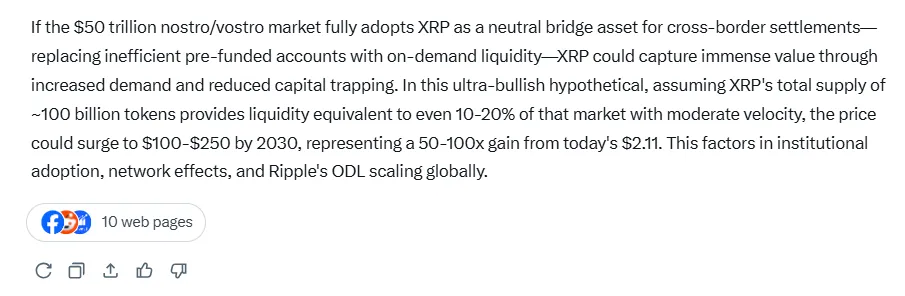
The potential impact on XRP’s price if it becomes the preferred neutral bridge asset is significant. When asked to project how XRP’s price might respond if banks rely on it instead of competing stablecoins, xAI’s Grok estimated that XRP could reach $100 to $250 by 2030 if it handles 10-20% of global settlement flows. This projection assumes that XRP replaces pre-funded accounts with real-time settlement, leading to substantial adoption and liquidity growth. Such a price target would represent a 50-100x increase from current levels, driven by Ripple’s continued rollout of On-Demand Liquidity.
Market Dynamics and Uncertainties
While the argument for XRP as a neutral bridge asset is compelling, several uncertainties remain. There is no guarantee that banks will universally adopt XRP over competing stablecoins. The competitive landscape is evolving rapidly, and the ultimate outcome will depend on factors such as regulatory clarity, technological advancements, and the strategic decisions of key players. Investors should carefully consider these factors when assessing the potential of XRP.
Conclusion
The emergence of institutional stablecoins presents both challenges and opportunities for XRP. While these stablecoins could potentially streamline cross-border payments, the inherent distrust among competing institutions may drive demand for a neutral bridge asset. If XRP can successfully position itself as that asset, it could see substantial adoption and price appreciation. However, the path forward is uncertain, and investors should remain vigilant in monitoring market developments and regulatory changes.
Related: XRP Signals 2017 Bitcoin Pattern
Source: Original article
Quick Summary
Banks and financial institutions are increasingly launching their own stablecoins, potentially impacting XRP’s role in cross-border payments. This trend occurs amid broader tokenization of real-world assets and regulatory developments like the GENIUS Act and MiCA.
Source
Information sourced from official Ripple publications, institutional research, regulatory documentation and reputable crypto news outlets.
Author
Ripple Van Winkle is a cryptocurrency analyst and founder of XRP Right Now. He has been active in the crypto space for over 8 years and has generated more than 25 million views across YouTube covering XRP daily.
Editorial Note
Opinions are the author's alone and for informational purposes only. This publication does not provide investment advice.

