







Speculation surrounds XRP potentially being classified as a Tier-1 asset by the Bank for International Settlements (BIS). The current BIS framework does not allow unbacked crypto assets like XRP to be classified as Tier-1 assets, which are reserved for the safest bank capital.
What to Know:
- Speculation surrounds XRP potentially being classified as a Tier-1 asset by the Bank for International Settlements (BIS).
- The current BIS framework does not allow unbacked crypto assets like XRP to be classified as Tier-1 assets, which are reserved for the safest bank capital.
- A change in classification could significantly increase XRP’s price, but would require a major shift in regulatory posture.
Recent discussions have centered on the possibility of XRP attaining Tier-1 asset status, a classification that would significantly alter its role in global finance. While this prospect has excited XRP proponents, the reality is more complex given the current regulatory landscape. Understanding the implications of such a classification and the hurdles involved is crucial for institutional and high net worth investors.
The Significance of BIS Tier-1 Assets
Tier-1 assets, as defined by the BIS Basel Accords, represent the highest quality capital that banks hold to ensure solvency and stability. These assets, which include cash reserves, government debt, and physical gold, provide a buffer against losses and demonstrate a bank’s financial strength to regulators. The composition of Tier-1 capital is critical for maintaining confidence in the banking system during periods of market stress.
Current Crypto Asset Classification by BIS
The BIS has established specific rules for how banks can handle crypto assets, categorizing them into two groups. Group 1 includes tokenized real-world assets and stablecoins meeting strict criteria, allowing them to be treated similarly to their underlying assets. Group 2 encompasses unbacked cryptocurrencies like XRP, Bitcoin, and Ethereum, which face stringent restrictions. Banks can only hold a minimal amount of Group 2 assets relative to their Tier-1 capital, typically around 1-2%, reflecting the perceived higher risk.
Hypothetical Impact of Tier-1 Status on XRP Price
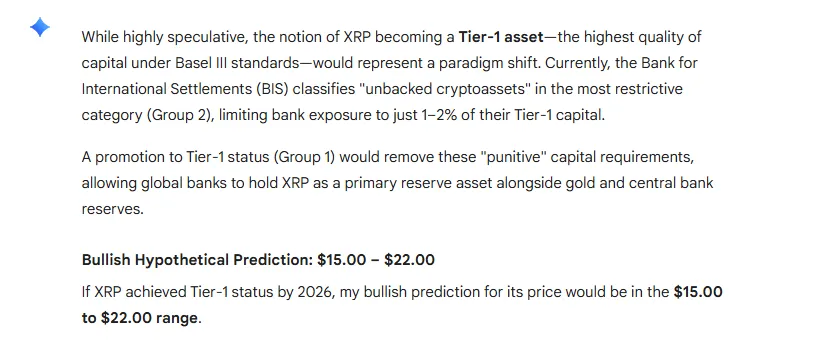
The CEO of Digital Ascension Group recently speculated that XRP is moving closer to becoming a global bridge currency and might one day receive recognition from the Bank for International Settlements as a Tier-1 asset. This has led to discussions about what might happen if regulators change their approach. If XRP were to achieve Tier-1 status, banks could treat it like cash, gold, or central bank reserves, eliminating the strict capital penalties currently in place. Google Gemini AI estimates that such a move could potentially drive XRP’s price to between $15 and $22 by 2026.
Regulatory Hurdles and Market Realities
Despite the optimistic price predictions, it’s important to recognize that current BIS rules do not provide a clear path for XRP or any other unbacked crypto to qualify as a Tier-1 asset. The Basel framework is designed to ensure financial stability, and the current categorization of crypto assets reflects concerns about their volatility and lack of inherent backing. For XRP to be reclassified, global regulators would need to significantly revise their framework or acknowledge substantial real-world utility and proven stability, neither of which is guaranteed.
XRP’s Potential as a Bridge Currency
XRP’s potential as a bridge currency hinges on regulatory acceptance and widespread adoption by financial institutions. While Ripple has made strides in developing cross-border payment solutions, regulatory uncertainty remains a significant hurdle. Achieving Tier-1 status would require convincing regulators of XRP’s stability and its ability to facilitate secure and efficient international transactions. Until then, the prospect of XRP becoming a Tier-1 asset remains a distant possibility.
In conclusion, while the idea of XRP attaining Tier-1 asset status is enticing, it is crucial to maintain a balanced perspective. The current regulatory environment and the inherent risks associated with unbacked crypto assets make this outcome unlikely in the near term. Investors should closely monitor regulatory developments and focus on the practical applications of XRP in the evolving landscape of digital finance.
Related: XRP ETF Flows Signal Huge Institutional Demand
Source: Original article
Quick Summary
Speculation surrounds XRP potentially being classified as a Tier-1 asset by the Bank for International Settlements (BIS). The current BIS framework does not allow unbacked crypto assets like XRP to be classified as Tier-1 assets, which are reserved for the safest bank capital.
Source
Information sourced from official Ripple publications, institutional research, regulatory documentation and reputable crypto news outlets.
Author
Ripple Van Winkle is a cryptocurrency analyst and founder of XRP Right Now. He has been active in the crypto space for over 8 years and has generated more than 25 million views across YouTube covering XRP daily.
Editorial Note
Opinions are the author's alone and for informational purposes only. This publication does not provide investment advice.

